Tuesday, 2 October 2018

For first time, new iPhones get weak response in India

Apple’s new iPhone XS and XS Max saw lower sales in the Indian market with several large retailers across the country saying they are for the first time left with little less than half the stock supplied to them after the first weekend sales.

This is in stark contrast to earlier years when demand would be much higher than supplies with Indian shoppers queuing up outside stores to grab the new iPhone. Apple had imported about a lakh units of the new iPhones, expanded availability to more stores and more markets to ensure high sales momentum at launch.

ET spoke to four large multibrand retail chains and three Apple Premium Resellers (APR) chains across the country with more than 1,500 stores among them. Senior executives in these chains said 40-45% of the stock was unsold as of Sunday night


While demand was better than last year’s iPhone 8, which too had muted response in India, sales of iPhone XS and XS Max were about 55-60% compared to last year’s iPhone X in the first three days of the launch.

More than half the demand has been for the pricier iPhone XS Max 256 GB model in gold colour priced Rs 1,24,900, they said. Apple launched iPhone XS and XS Max last Friday priced at Rs 99,900 to Rs 1,44,900 against last year’s iPhone X launch price of Rs 89,000 to Rs 1.02 lakh.

Brian Bade, CEO at India’s largest consumer electronics retail chain Reliance Digital, said the retailer is still left with stock of the new iPhones. He, however, said some pre-booked customers are yet to collect the models probably postponing it to ride past the inauspicious period of Shradh.

“While sale of the new iPhones in the first weekend was certainly more than iPhone 8 of last year, it is still less than iPhone X. It’s a super-premium smartphone and will take some time to sell in India,” Bade said. He expects sales to pick up when Navratri starts in the second week of October.

Subhas Chandra, MD at Bengaluru-based Sangeetha Mobiles which operates 540 stores, said there has been no growth in same-store sales over last year for the new iPhones and there is still stock left. “However, in absolute terms, we sold more number of units of the new iPhones as compared to last year due to higher stock availability and since we also expanded the number of stores by adding 175 outlets,” he said.

Analysts said October-December shipment of iPhones in India can grow this year based on the older models unlike earlier years when the new launches would drive it.

Hong Kong-based Counterpoint Research associate director Tarun Pathak said that demand for the new iPhones might be spread across the quarter in the middle of the festive season compared to Apple’s previous launches.

“Having said that, Apple might still find it challenging to sell new iPhones beyond hard core Apple affluent users,” he said. Apple India did not respond to an email seeking comment. 

Aadhaar verdict fallout: Firms, govt brace up for requests to delink data

Private enterprises, as well as various government departments, may be staring at a situation of confusion post the Supreme Court’s verdict on Aadhaar, which has allowed people to request for deletion of their Aadhaar data from the database of companies.

According to experts, companies and government agencies that were heavily relying on Aadhaar for customer verification, may be flooded with requests for deletion in the coming weeks.

“Since the judgement came on Wednesday, there has been a spike in the number of people who have signed the petition to optout of Aadhaar and a form which has been published to delink Aadhaar from existing database has seen a spate of downloads from its website,” said Raghu Godavar, member of the group Rethink Aadhaar.
While companies have been waiting for directions from Unique Identification Authority of India (UIDAI) or their respective ministries, the former has said that sectoral regulators have to provide clarity in this regard.

Ajay Bhushan Pandey, CEO of UIDAI told ET that as far as UIDAI is concerned, the authentication log has to be deleted after six months and the authority will delete it.

“This is the part that concerns us. The part that concerns other agencies and regulators has to be looked at by them. And they need to do what is required as per the order,” he said. Some customers have already expressed questions on social media over the process to delete their Aadhaar information.

“We should be allowed to de-link if it is associated with bank account. (There should be) assurance by third parties that historical data has been purged,” said Nitin Bhatnagar, assistant vice president at SISA, a payment security specialist firm.

Ramanjit Singh Chima, policy director at Access Now, said companies will have to figure a mechanism to facilitate such requests by people demanding the deletion of their data.

“Companies need to proactively reach out to their customers and seek alternative KYC and government agencies like the department of telecom or regulators such as TRAI need to give guidance on this,” he said.

Chima added the ministries need to start taking proactive steps and informing consumers.

For people who don’t have any proof of identity apart from Aadhaar—an estimated 400 million—companies will have to either accept paper-based Aadhaar in lieu of e-KYC on a voluntary basis.

Apart from banks and telecom companies, a host of government and private services, too, have linked to Aadhaar.

Of the Employee Provident Fund Organization’s 60 million members, as many as 50 million have already seeded their Aadhaar with their PF accounts. More than 13.6 million residents have used Aadhaar for passport services. The Election Commission has also linked the Aadhaar numbers of nearly 38 crore voters.

Privacy experts say consumers can write to companies to delink their Aadhaar details, though banks and telecom firms may not be able to immediately oblige stating that they have not received a notification from the government.

“The judgement makes it clear the linking isn’t permitted. But the modalities to that are yet to be announced,” said Rishab Bailey, legal consultant and privacy policy researcher.

Technologists say it wouldn’t take long for companies to comply with requests for data deletion if they choose to do so.

“Depending on which application they have stored their data in, they have to scan those applications and databases. They can either include the option of retrieval and deletion of data to the old application, or write a separate application that scans through the entire database of the banking or telecom application and make sure they delete that,” said a financial services technology adviser with a Bengaluru-based IT services firm.

Data deletion will not be a “massive technological overhead” for companies, this person said.

Zomato, TripAdvisor and other third-party apps say Facebook data breach didn’t affect them

Zomato, TripAdvisor and dating app Truly Madly said their Indian users have not been impacted by the Facebook data breach that led to about 50 million accounts getting exposed to hackers globally.

Experts had said the hacking, which was revealed by the social networking platform on Friday, would have exposed third-party apps of users that accept Facebook logins.

“Facebook has been in touch with us and as far as we understand, there is no impact to Zomato users and their usage of Zomato as a result of this breach at Facebook,” a Zomato spokesperson said. The online food delivery and restaurant discovery company has about 120,000 users across Zomato Treats and about 160,000 across Zomato Gold.

Facebook had about 270 million users in India at the end of July, according to the Statista website. Some companies allow users to access their apps through Facebook logins.


A TripAdvisor spokesperson told ET that at this time, there is no evidence that any of its user information has been affected or compromised. Hotstar and BookMyShow didn’t respond to emails seeking comment till the time of going to press.

Rahul Kumar, cofounder of dating app Truly Madly, which requires a Facebook login, said his users were not impacted by the data breach. Aditya Gupta, cofounder of iGenero, said dating apps that are solely dependent on Facebook logins for access could be the most affected by the hack.

“People use Facebook logins to avoid creating other new accounts on apps and they think it’s convenient. Going forward, this will be a big issue for third-party apps and they might be figuring how to reduce dependency on the platform,” Gupta said.

Globally, dating app Tinder has asked Facebook to share more information on the breach.

Facebook said on Friday that hackers had exploited a bug in a feature that lets users see their Facebook page as others would. The hackers were able to take over the accounts and use them as if they were the account holders. That included posting or viewing information shared by friends on those accounts. Facebook said no credit card information stored with the company was accessed.

More than 90 million users were forcibly logged out of their accounts by Facebook and had to log back in on Friday for security reasons.

Alibaba planning to bring its China retail playbook to India

As Alibaba looks to expand its cloud business in India, having launched its second data centre in the country last week, it is looking to work with players in the retail space to bring its popular ‘new retail’ concept to India.

The company is even looking at bringing technology it is using in China such as augmented reality (AR) used in shopping events such as Single’s Day to the Indian retail industry to enhance the customer experience.

Alibaba Cloud has so far announced only its partnership with DLF shopping malls, but is said to be in talks with other major retail players as well.

“Retail has been a big focus for us in India,” said Vivek Gupta, head of business development for India and Saarc at Alibaba Cloud.

“We are talking to almost every single retail brand in the country. We want to partner with them in their omni-channel journey, as well as strengthen supply chain, offer intelligence on business operations, and enhance customer experience,” Gupta said.

Alibaba’s ‘new retail’ concept, coined by founder Jack Ma, includes a personalised experience for a customer in a physical store, customer analytics for offline stores to offer matching products, and integrating online experience at offline stores through customisation and deliveries.

“We think these products will meet the needs of the retail industry in the region who are looking to digitise their operations,” Gupta said.

According to one person aware of developments, augmented reality (AR) is also something Alibaba is looking to bring to the retail space in India. Alibaba had launched Taobao Buy as an AR experience application for shoppers two years ago.

“AR is used extensively during 11/11 shopping festivals,” Gupta said, referring to the popular Single’s Day celebrations in China.

“In China, Alibaba owns malls, stores as well as online platforms, and we can bring our experience here,” he said.

Other bets
Gupta said he could not comment on “futuristic” plans on AR. He also did not comment on Alibaba Cloud’s partnership with Paytm Mall, the e-commerce arm of Paytm, which is also focusing on omni-channel. Alibaba is an investor in Paytm Mall and parent company One 97 Communications.

Paytm Mall did not respond to queries. Alibaba Cloud had recently partnered with Paytm to launch the Paytm AI cloud, the Indian company’s foray into the cloud business “Paytm is a key partner in India. We will be the technology enabler in terms of enabling the Paytm AI Cloud,” Gupta said.

Apart from retail, Alibaba Cloud is also focusing on other verticals in the country for adoption. “Internet-enabled business around e-commerce, gaming are big business for us. We have seen strong adoption in media and entertainment, as well as in the manufacturing industry,” Gupta said.

Apollo Data Breach Leads To More Than 200 Million Contact Records Stolen

Data breaches, hacking attempts, data stealing, all these terms have now become something of a routine for the corporate sector. Once again, a massive hack allowed the attackers to pilfer over 200 million records. This time, the victim is a sales engagement company Apollo. The reports about the Apollo data breach surfaced online after the firm began notifying the customers.

Apollo Data Breach Exposed 200 Million Contact Database To Hackers

As disclosed by TechCrunch, the startup sales revenue and engagement service Apollo suffered a massive hack stealing millions of data records. Precisely, the company lost around 200 million records from its contact database in the Apollo data breach.

Reportedly, Bjoern Zinssmeister of Templarbit found an email generated by Apollo to its customers informing them of a breach. Zinssmeister shared the email with TechCrunch who then shared the contents of the email with the public.

According to the email, Apollo noticed the breach “weeks after system upgrades in July”. Explaining the details of the hacked data, the email read,

While the hackers have stolen contact information from Apollo’s database, the firm confirmed that financial details, Social Security numbers or other sensitive data remained unaffected as the firm does not store these details.

Investigations Underway
Right after noticing the breach, Apollo began investigating the matter. While the investigations are still in progress, Tim Zheng, CEO Apollo, said in his email that the firm informed the customers regarding the incident to comply with their transparency values. However he refused to give more details, as stated in his email,

Although the Apollo data breach merely exposed the “publicly gathered” information to the hackers, and so, some people may think of it as potentially less harmful. However, it certainly succeeds in getting listed among the top hacking attempts and data breaches happened this year such as the Chegg data breach, and the breach at the fashion retailer SheIn that affected millions of customers.

Let us know your thoughts in the comments section.

New iPhone Passcode Bypass Hack Exposes Photos and Contacts

Looking for a hack to bypass the passcode or screen lock on iPhones?
Jose Rodriguez, an iPhone enthusiast, has discovered a passcode bypass vulnerability in Apple’s new iOS version 12 that potentially allows an attacker to access photos and contacts, including phone numbers and emails, on a locked iPhone XS and other recent iPhone models.
Rodriguez, who also discovered iPhone lock screen hacks in the past, has posted two videos (in Spanish) on his YouTube channel under the account name Videosdebarraquito demonstrating a complicated 37-step iPhone passcode bypass process.

The iPhone authorization screen bypass flaw works on the latest iPhones, including the iPhone XS, running Apple's latest iOS 12 beta and iOS 12 operating systems.
Video Demonstrations: Here's How to Bypass iPhone Passcode
As you can watch in the video demonstrations, the iPhone hack works provided the attacker has physical access to the targeted iPhone that has Siri enabled and Face ID either disabled or physically covered.

Once these requirements are satisfied, the attacker can begin the complicated 37-step iPhone passcode bypass process by tricking Siri and iOS accessibility feature called VoiceOver to sidestep the iPhone's passcode.
Soon after Rodriguez released his videos, a tech channel on YouTube under the handle EverythingApplePro published a video in English explaining the same passcode bypass hack on iPhone XS.

This iPhone passcode bypass method potentially allows the attacker to access the contacts stored in the iPhone, including phone numbers and email addresses, and to access Camera Roll and other photo folders, by selecting a contact to edit and change its image.
Though Apple has some built-in security measures to prevent this from happening, Rodriguez found a way to bypass those security barriers, as you can see in the video.
Here's how to Fix the iPhone Passcode Bypass Bug
The passcode bypass methods work on all iPhones including the latest iPhone XS lineup, but the company does not appear to have patched the vulnerabilities in the latest iOS 12.1 beta.

Until Apple comes up with a fix, you can temporarily fix the issue by just disabling Siri from the lockscreen. Here's how to disable Siri:
Go to the Settings → Face ID & Passcode (Touch ID & Passcode on iPhones with Touch ID) and Disable Siri toggle under "Allow access when locked."
Of course, disabling Siri would cripple your iOS 12 experience, but would prevent attackers from abusing the feature and breaking into your iPhone.
Meanwhile, just wait for Apple to issue a software update to address the issue as soon as possible.
iPhone passcode bypass hack has become common over the last few years and appears almost after every iOS release. An iOS 9.3.1 passcode bypass was found last year, allowing an attacker to bypass Siri to search Twitter and gain access to locked iPhone's photos and contacts.

TCS conducts online test to hire engineering graduates; move aimed at covering larger talent base

While TCS is moving toward a digitised process of hiring, the company is not ending the campus recruitment process, says the company.

IT services bellwether, TCS, will focus more on online tests to recruit fresh engineering graduates. The move could be of great significance for students who would otherwise have been deprived of campus placements because of their colleges.

According to a report in The Times of India, TCS held an all-India online test - called the National Qualifier Test. The Bengaluru-headquartered firm is following it up with video interview, or a face-to face interview, depending on applicant's location.

"While TCS is moving toward a digitised process of hiring, the company is not ending the campus recruitment process," the company said in a statement.

The online recruitments will enable the IT firm to reach out to a far larger talent base irrespective of candidate's geographical location. TCS will also be able to finish up with hiring process in three-four weeks, which is way less time than the three-four months it took under the conventional method.

TCS earlier had a pool of 370 colleges from where it hired most of the fresh graduates. However, after the online test, the company reportedly said it could reach out to nearly 2,000 colleges, including those "in Baramulla, Kohima and other far-flung areas".

Last year, TCS had hired about 20,000 trainees. This year, it expects to bring more engineers onboard.

The number of students who registered for the test on the company's digital platform iON was 280,000 from 100 cities and 24 states, the report said, adding that this figure is 175 per cent higher than the number of students who registered for the traditional process last year.

"The basic process of campus recruitment is not changing but the way we are doing is changing... We have optimised recruitment so that it can be done faster in three to four weeks," Ajoy Mukherjee, executive VP and head of global human resources at TCS, told TOI.

For the current year, the tests were conducted earlier this month, and the interview process is going on. "We could not go to colleges in far-flung areas. Now they come together in one nearby accredited college or an iON centre for the interview," Mukherjee added.

The traditional campus recruitment process, however, will continue in top institutions such as the IITs, NITs and IIMs, the report added.

Friday, 23 June 2017

32TB of Secret Windows 10 Internal Builds & Partial Source Code Leaked Online

A massive archive of Microsoft's top-secret Windows 10 builds, and the source codes for private software has been reportedly leaked online, which could lead to a nasty wave of Windows 10 exploits.

The Leaked files – uploaded on BetaArchive website – contains more than 32 terabytes of data, which includes many non-public Windows 10 and Windows Server 2016 builds created by Microsoft engineers for testing purpose.


Interestingly, Windows 10 internal builds include private debugging symbols defined by the engineers usually to help other in-house developers understand how some specific codes in the operating system works and what functions it calls, the Register reports.
microsoft-internal-windows-10-builds

Private debugging symbols reveal some sensitive in-depth knowledge about the operating system that could be used by exploit writers to find vulnerabilities.

Moreover, the dump also contains Microsoft's Shared Source Kit, which includes source code for Windows 10 hardware drivers, such as:

  • Plug-and-Play system
  • USB Stacks
  • Wi-Fi Stacks
  • Storage Drivers
  • ARM-specific OneCore kernel code
According to Microsoft's website, Shared Source Kit is available only for "qualified customers, enterprises, governments, and partners for debugging and reference purposes."

However, BetaArchive has now removed the confidential ‘Shared Source Kit’ from its servers.

“We have removed it from our FTP and listings pending further review just in case we missed something in our initial release. We currently have no plans to restore it until a full review of its contents is carried out, and it is deemed acceptable under our rules.” BetaArchive said.

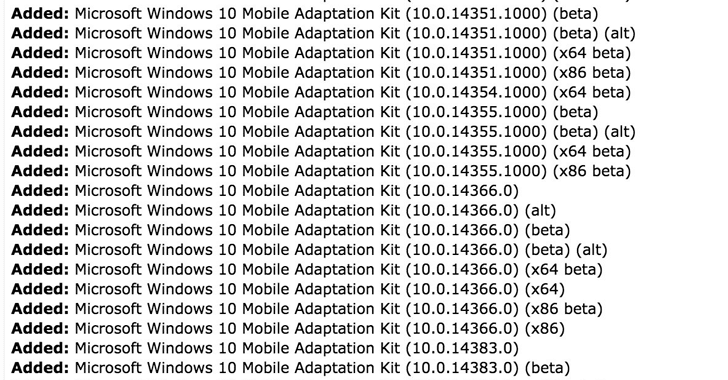
microsoft-windows10-mobile-adaptation-kit

The leaked files also contain Microsoft's Windows 10 Mobile Adaptation Kit, a private software toolkit created by Microsoft designed to run Windows 10 operating system on mobile devices.

So far, it’s unclear who is behind this massive leak, but it could be from one of the Microsoft OEM partners.

Stay tuned for more information.

Friday, 19 May 2017

Zomato Hacked; Hacker Puts Up 17 Million Users' Emails and Passwords On Sale


If you ever ordered food from Zomato, You should be Worried!

India's largest online restaurant guide Zomato confirmed today that the company has suffered a data breach and that accounts details of millions of its users have been stolen from its database.

In a blog post published today, the company said about 17 Million of its 120 Million user accounts from its database were stolen.

What type of information?


The stolen account information includes user email addresses as well as hashed passwords.

Zomato claims that since the passwords are encrypted, it cannot be decrypted by the attackers, so the "sanctity of your password is intact."

It seems Zomato is downplaying the threat or unaware of the fact that these days hackers are using cloud computing, which enables them to decrypt even a 15-18 character passwords within a few hours. So there's no guarantee your passwords will not eventually get cracked.

Update: As shown in the above screenshot taken immediately after they updated their blog post, Zomato has changed its statement from "your password can not be converted/decrypted" to "can not be easily converted" back to plain text.

The updated statement now reads:
"We hash passwords with a one-way hashing algorithm, with multiple hashing iterations and individual salt per password. This means your password cannot be easily converted back to plain text."
Also, Zomato stressed that the breach did not impact or compromise any payment card data, as the financial information of its customers is stored in a separate database different from the one illegally accessed.
"Payment related information on Zomato is stored separately from this (stolen) data in a highly secure PCI Data Security Standard (DSS) compliant vault. No payment information or credit card data has been stolen/leaked," the company claims.

17 Million Zomato Accounts Sold on Dark Web

17 Million Zomato Accounts Sold on Dark Web
According to HackRead, a user going by the online moniker of "nclay," who claimed to have hacked Zomato, is selling data of 17 Million registered Zomato users on a popular Dark Web marketplace.

The vendor also shared a sample data to verify the authenticity of the leaked database and is asking for 0.5587 Bitcoins (around $1017 or ₹65,261) for the entire set of data.
Though Zomato has partnered with

 HackerOne Bug Bounty Platform, hacker preferred to put up data on sale, which indicates it could be an internal breach, instead of exploiting a flaw.

The company believes that someone from inside its organization is responsible for the security breach.
"Our team is actively scanning all possible breach vectors and closing any gaps in our environment. So far, it looks like an internal (human) security breach - some employee’s development account got compromised," the company said.

What should Zomato Customers do?


Customers should particularly be alert of any phishing email, which are usually the next step of cyber criminals after a breach to trick users into giving up further details like financial information.

For the obvious reasons, all customers are highly recommended to change their passwords for Zomato accounts as soon as possible, along with other websites that are using the same passwords, and choose unique passwords for different accounts.

If you can't create or remember complex passwords for different sites, you can make use of a password manager.

We have listed some good password managers for Android, iOS, Windows, Linux and Mac platform that could help you understand the importance of password manager and choose one according to your requirement.

WannaCry Ransomware Decryption Tool Released; Unlock Files Without Paying Ransom

wannacry-ransomware-decryption-tool-unlock-files-free
If your PC has been infected by WannaCry – the ransomware that wreaked havoc across the world last Friday – you might be lucky to get your locked files back without paying the ransom of $300 to the cyber criminals.

Adrien Guinet, a French security researcher from Quarkslab, has discovered a way to retrieve the secret encryption keys used by the WannaCry ransomware for free, which works on Windows XP, Windows 7, Windows Vista, Windows Server 2003 and 2008 operating systems.

WannaCry Ransomware Decryption Keys


The WannaCry's encryption scheme works by generating a pair of keys on the victim's computer that rely on prime numbers, a "public" key and a "private" key for encrypting and decrypting the system’s files respectively.
To prevent the victim from accessing the private key and decrypting locked files himself, WannaCry erases the key from the system, leaving no choice for the victims to retrieve the decryption key except paying the ransom to the attacker.

But here's the kicker: WannaCry "does not erase the prime numbers from memory before freeing the associated memory," says Guinet.

Based on this finding, Guinet released a WannaCry ransomware decryption tool, named WannaKey, that basically tries to retrieve the two prime numbers, used in the formula to generate encryption keys from memory, and works on Windows XP only.

Note: Below I have also mentioned another tool, dubbed WanaKiwi, that works for Windows XP to Windows 7.

"It does so by searching for them in the wcry.exe process. This is the process that generates the RSA private key. The main issue is that the CryptDestroyKey and CryptReleaseContext does not erase the prime numbers from memory before freeing the associated memory." says Guinet

So, that means, this method will work only if:
  • The affected computer has not been rebooted after being infected.
  • The associated memory has not been allocated and erased by some other process.
"In order to work, your computer must not have been rebooted after being infected. Please also note that you need some luck for this to work (see below), and so it might not work in every case!," Guinet says.

"This is not really a mistake from the ransomware authors, as they properly use the Windows Crypto API."

While WannaKey only pulls prime numbers from the memory of the affected computer, the tool can only be used by those who can use those prime numbers to generate the decryption key manually to decrypt their WannaCry-infected PC’s files.


WanaKiwi: WannaCry Ransomware Decryption Tool

Good news is that another security researcher, Benjamin Delpy, developed an easy-to-use tool called "WanaKiwi," based on Guinet's finding, which simplifies the whole process of the WannaCry-infected file decryption.

All victims have to do is download WanaKiwi tool from Github and run it on their affected Windows computer using the command line (cmd).

WanaKiwi works on Windows XP, Windows 7, Windows Vista, Windows Server 2003 and 2008, confirmed Matt Suiche from security firm Comae Technologies, who has also provided some demonstrations showing how to use WanaKiwi to decrypt your files.

Although the tool won't work for every user due to its dependencies, still it gives some hope to WannaCry's victims of getting their locked files back for free even from Windows XP, the aging, largely unsupported version of Microsoft's operating system.

Wednesday, 12 October 2016

Pak hackers target LDRP Institute site

On Monday, those who visited the website of the LDRP Institute of Technology and Research,Gandhinagar, found its home page defaced by a Pakistan-based hacker group. The group had left the message, "party has just started".

It is one of the many instances of Indian institutions being targeted by Pakistani
 hackersover the past month. Cyber security experts said that a web page of an Ahmedabad-based university and the web page of an IIT were also hacked on Monday. But these pages were quickly repaired.


S K Mantrala, the registrar of Kadi Sarva Vishwavidyalaya (KSV), told media on Tuesday that a complaint would be filed after Wednesday as Tuesday and Wednesday are public holidays. "We will gather required information about the incident and approach police," he said.


City-based cyber security experts said that after India's surgical strikes across the LOC, the incidents of organized cyber attacks from Pakistan have risen dramatically. Indian hacker groups are also retaliating by targeting websites of Pakistan government and institutions.


"The defacements are also about accessing unsecured database," said an expert. "As was seen in the recent Yahoo security breach, data today is worth millions of dollars. Thus, while recovering the site, focus should also be on securing data."


Sunny
 Vaghela, an Ahmedabad-based cyber security expert, said that theGovernment of India has already made it compulsory for websites and applications using public data for business or other purposes to undergo a security audit.

Monday, 18 July 2016

Airtel rolls out 4G services in 1800Mhz band in Bengaluru

The country's number one telecom service provider Airtel has rolled out 4G services in Bengaluru under 1800 MHz spectrum band using FD LTE technology. The company claims that this will provide superior mobile broadband experience and better network coverage to Airtel subscribers in the city.

Airtel launched its
 4G Serviceon mobile in the city in February 2014 in the 2300 MHz band using TD LTE standard. With this launch Bengaluru becomes the first few cities to enjoy 4G network using TD and FD carriers.

The launch is a part of
 Airtel ongoing network transformation programme called Project Leap. As part of the programme, Airtel is offering immediate 4G sim changes and home delivery of sim cards within four hours. 4G data plans are available at the same tariffs as those of existing 3G plans.


Recently,Airtel reduced prepaid data tariffs on some of its pre-paid data recharge packs to offer up to 67% more data package to customers.


Under the revised data plans, the Rs 655 4G/3G
 monthly recharge pack will now offer 5GB data vs 3GB earlier, an increase of 67%. Similarly, the Rs 455 pack 4G/3G pack now offers 50% more data by increasing data limit to 3GB from 2GB. The Rs 989 4G/3G pack will now offer 10GB data vs 6.5GB offered earlier.


The 2G/3G/4G Sachet Packs also see major increase in data packs. The Rs 25 2G pack now offers 45% more data at 145 MB vs 100 MB earlier, while the Rs 145 4G/3G pack now offers 32% more pi data benefits at 580 MB vs 440 MB earlier. Even the Rs 5 one day 2G data pack benefits have been increased by 48% to 30 MB keeping in mind non-regular/first time users, particularly in rural markets

Saturday, 14 May 2016

New Sessions Added To Google I/O 2016 Schedule


Google posted at least some of the events and sessions for developers to check out at the Google I/O trade conference already. It looks like the Big G wasn't quite finished ironing out the details, because several new sessions have been added to the official website as of today. Here are a few of them that are particularly relevant to Android:
Some of the above office hours are doubled up on Day 3 as well. There are also a wide selection of "After Hours" events added to Day 2 (May 19th), which are essentially a combination of social mixers and fun demonstrations. One in particular, "After Hours: Phantogeist with AR gameplay and Project Tango," says that attendees will "use your Project Tango device as a special scanner to defend yourself and Earth from the creatures by zapping them." That might mean that Google I/O's giveaway hardware could include a Project Tango tablet this year... or it means that they'll be provided at the event, or that attendees will be expected to bring their own.

Saturday, 9 May 2015

Sony launches Xperia C4 and C4 Dual

Sony launches Xperia C4 and C4 Dual
The phone runs Android 5.0 Lollipop, the latest version of Google's mobile operating system, and sports a 13MP autofocus rear camera with LED flash and 5MP front camera for selfies. 
 Sony has launched Xperia C4, along with a dual-sim variant, Xperia C4 Dual. 

The Japanese company did not reveal the prices of the smartphones, however, it mentioned that the devices will be available June onwards. 

Sony Xperia C4 sports a 5.5-inch full-HD (1080x1920p) IPS display. Powered by a 1.7GHz octa-core (Cortex-A53) MediaTek MT6752 processor coupled with 2GB RAM, the phone comes with 16GB internal storage expandable up to 128GB via microSD card. It's powered by a 2,600mAh battery which delivers up to 12 hours 47 minutes of talk time and up to 682 hours of standby time, as claimed by the company. 

The phone runs Android 5.0 Lollipop, the latest version of Google's mobile operating system, and sports a 13MP autofocus rear camera with LED flash and 5MP front camera for selfies. 

It measures 150.3x77.4x7.9mm and weighs 147 grams. In terms of connectivity, the phone supports Wi-Fi and Wi-Fi Hotspot, 4G LTE, 3G, Bluetooth 4.1, and aGPS. 

Just like its predecessor, Xperia C3, this smartphone too targets selfie-loving consumers. "Following the success of Xperia C3, we are proud to introduce Sony's evolved PROselfie smartphone," said Tony McNulty, vice-president, Value Category Business Management at Sony Mobile Communications. 

Xperia C4 has improved specifications in terms of camera, processor and battery. Xperia C3 was launched in India, September last year at Rs 23,990
.

Intex launches Aqua Life and Aqua Life II

Intex launches Aqua Life and Aqua Life II
Aqua Life II is a dual sim phone that runs on Android 4.4.2 KitKat and features a 5-inch FWVGA (480x854p) display. 
 Intex has expanded its Aqua series with the launch of two new smartphones — Aqua Life and Aqua Life II — priced at Rs 5,777 and Rs 5,555, respectively. Both the phones have been listed on the company website but there is no word on availability.

Aqua Life is a dual sim smartphone that runs Android 4.4.2 KitKat and features a 5-inch FWVGA (480x854p) display. Powered by a 1.3GHz quad-core MediaTek processor, the phone comes with 512MB RAM, and has 4GB of internal storage. Users can also install microSD cards of up to 32GB.

Aqua Life sports an 8MP primary camera with LED flash, has a 2MP front facing camera, and packs 2000mAh battery.

For connectivity, the smartphone offers 3G, GPRS/EDGE, Wi-Fi, Bluetooth v2.1 and a micro-USB slot, and is available in three colours — black, white, and blue.

The other smartphone, Aqua Life II, is also a dual sim phone that runs on Android 4.4.2 KitKat and features a 5-inch FWVGA (480x854p) display.

Powered by 1.2GHz quad-core spreadtrum processor and 1GB RAM, the phone comes with 8GB in built storage and can support microSD cards of up to 32GB.

The smartphone sports a 5MP primary camera with dual-LED flash and a 1.3MP secondary camera, and in terms of connectivity, includes support for 3G, Wi-Fi, Bluetooth, GPS/ A-GPS, and micro-USB.

Aqua Life II will be available in three colour variants — white and orange, black and blue, and blue
.

Disqus Shortname

Comments system